Monday, January 28, 2008

More about the Genetic Code - start codons, stop codons and degeneracy

Still staying on the same topic of the Genetic Code...Now let's learn more about it!

When decoding information on DNA, a messenger RNA (mRNA) transcript is first made by the process of transcription. The first codon on this mRNA transcript is almost always "AUG" which codes for the amino acid "methionine" or "M". This is referred to as the START codon. If you noticed, I had intentionally started my New Year's wish for you with "M" too!

aug
M A N Y

H A P P Y

D A Y S !

As the saying goes - where there is a beginning, there is also an end. In the case of a mRNA transcript, where there is a start codon, there is also a stop codon. In the Genetic Code, there are 3 different STOP codons that can be used. Any 1 of these 3 stop codons may be found at the end of a mRNA transcript.

The start codon "M" is indicated in orange and 3 stop codons are indicated in red, in the Genetic Code table below.


The 3rd noteworthy point about the Genetic Code is - DEGENERACY.

If you had been decoding my New Year's wish for you in my earlier post (5th Jan '08), you may have realized that the 3 "A"s found in the coded message were coded for by 3 different codons. Similarly so, for the 3 "Y"s and 2 "P"s.

gcc uau
M A N Y

gcg ccc cca uac
H A P P Y

gca uau
D A Y S !

This feature of the Genetic Code, where there is more than 1 codon coding for the same amino acid is termed "DEGENERACY".

I hope with this, you now understand start codons, stop codons and degeneracy of the Genetic Code! You can then create your own "DNA" encoded message! How about sending me one to decode! ;p

Monday, January 21, 2008

My New Year's Wish for You!

It is high time I came back with the decoded message of my New Year's wish for you! Here's wishing you...

M A N Y

H A P P Y

D A Y S

Hope all of you managed to decode that correctly! Especially after reading my post about how the genetic code works!

Now as a reward...how about listening to the title song of the classic American sitcom "Happy Days" in the video posted today!

Saturday, January 5, 2008

The Genetic Code - DNA decoded

We got for our son a very special birthday card this year (as seen above). In it, he had to crack a code in order to uncover what was wished for him in the card. So it is with DNA in our cells. The genetic information on DNA is written in a code - THE GENETIC CODE!

Recall, in my post before this titled "The DNA double helix - a story of 2 perfectly paired strands", I explained that there are 4 nitrogenous bases used in making a strand of DNA. These are adenine (A), thymine (T), cytosine (C) and guanine (G). These 4 bases (A,T,C and G) are used like letters in an alphabet. The sequence of these bases on DNA code for specific genetic information.

In order to use the encoded genetic information, the sequence of DNA bases is first copied onto RNA (ribonucleic acid) by a process called "transcription" (I will elaborate on this process in another post...for now, all you need to know is that DNA is copied onto RNA).

In RNA, the bases A, U (uracil), C and G bases are used. Notice in RNA there is no "T" , unlike DNA. Instead, a "U" is used in place of "T" in RNA. Recall, from my previous post, the nitrogenous bases in DNA exhibit complementary base pairing, where "A" pairs with "T" and "C" pairs with "G". It is via this complementary base pairing that the sequence of bases in DNA gets copied onto RNA. As in DNA, "C" pairs with "G". However, unlike DNA, "A" pairs with "U" in RNA (due to the absence of "T").

Every 3 bases on RNA code for 1 amino acid - where an amino acid is the building block of proteins. Hence, by reading every 3 bases on RNA, the cell is able to string together a chain of amino acids. We call this a "polypeptide" chain. Subsequently, each polypeptide chain made from RNA will be folded into a functional protein to be used by the body.

Below is the GENETIC CODE, showing which combination of 3 bases on RNA codes for which amino acid. Each of these combination of 3 bases on RNA is called a "codon".


From the above genetic code, we see that the codon "AUG" codes for the amino acid "methionine" and the codon "AAA" codes for the amino acid "lysine".

Each amino acid may also be represented using a single letter code as shown in the table below.


So, the codon "AUG" codes for the amino acid "methionine", which can be represented by the single letter code "M". And the codon "AAA" that codes for the amino acid "lysine", can be represented by the single letter code "K". Note that the single letter representation for the amino acid need NOT correspond to the first letter of that amino acid!

Having understood the genetic code...now try decoding my New Year's wish for you below! You can do so by matching each codon to its amino acid. Then match the amino acid coded for to its single letter code.


Eg. "AUG" - "M" and "AAA" - "K".


AUG GCC AAU UAU


CAC GCG CCC CCA UAC


GAC GCA UAU UCA !


Managed to crack my "New Year's wish" code?! Check back for my next post to see if you got the answer right! Good luck!

Saturday, December 29, 2007

The DNA double helix-a story of 2 perfectly paired strands

Today was my niece's wedding day! They had a lovely Catholic church service followed by a delightful lunch reception. Weddings tend to leave a lingering sweet, warm feeling to all who witness the joyful union of 2 becoming 1.

Some couples have very similar characters and interests, yet others attract total opposites from themselves! As for DNA found in our cells...this is a story of the perfect complement. Each of the 2 strands comprising the DNA double helix were "made for each other"! Let me explain...

DNA - deoxyribonucleic acid, is made up of of 2 strands of polynucleotides. Each strand of polynucleotide is a polymer of monomer units called - nucleotides. Each nucleotide comprises 3 components - a phosphate group, a sugar group and a nitrogenous base.

Nucleotides join to make a single strand of polynucleotide via phosphodiester bonds between alternating phosphate and sugar groups. We call this the "sugar-phosphate backbone" of a single strand of polynucleotide.


Now, this is where the love story begins...How do 2 polynucleotide strands come together to become 1 DNA macromolecule? They do so through their complementary base pairing between their nitrogenous bases. There are 4 different nitrogenous bases - Adenine (A), Thymine (T), Cytosine (C) and Guanine (G). These display specific base pairing where "A" will always pair up with "T" and "C" will always pair up with "G". Hence, when there is an "A" on 1 polynucleotide strand, this will pair up with "T" on the opposite polynucleotide strand. Similarly, when there is a "C" on 1 polynucleotide strand, this will pair up with "G" on the opposite polynucleotide strand. It is via this complementary base pairing that 2 polynucleotide strands come together to make 1 DNA macromolecule. What wedded bliss!


Tuesday, December 25, 2007

Merry Christmas !!!

Here's a video of a group of Genetics Students singing Christmas carols with a DNA "twist"!
Have a funfilled, Merry Christmas :)

Sunday, December 23, 2007

What the heck are macromolecules anyway?

My son's lego creation (as seen in this post) was built from individual Lego blocks. Similarly, our bodies are built from individual units called "cells". There is a big difference though - as Lego blocks are non-living objects whereas our cells are alive! Infact, a cell is the smallest unit of life!

What differentiates a living cell and a non-living Lego block? Well, all living things are capable of the following:
- acquire & utilize energy
- reproduce
- respond to the environment
- carry out controlled chemical reactions
- maintain homeostasis

What then can I say is the function of a Lego block? Perhaps, the following:
- It should be a non-toxic and safe toy
- It should be moulded into precise shapes for the precise connection to other blocks.
- It should be sturdy and durable

A Lego block's functional requirements are relatively simple. As such, its chemical composition that goes into making a Lego block should be relatively simple. My guess is that the Lego block would be made up of a durable, non-toxic type of plastic chemical.

In contrast, the living cell's functional requirements are very complex. Hence, the chemical composition that goes into making up a cell must be complex. Basically, our cells and its components therein are made up of 4 main classes of complex chemical structures. These chemical structures are what biochemists refer to as "macromolecules".

Macromolecules are called as such because they are relatively large, complex molecules made up from smaller chemical units. For details about the chemistry of macromolecules, please refer to the following link - http://oh.essortment.com/whataremacromo_rcpy.htm.

Just like the structure of a durable, non-toxic, plastic chemical would fulfill the function of a simple Lego block; the structures of macromolecules fulfill their respective functions in the cell to sustain life! So, let me briefly run through a few key structure-function relationships of the 4 main macromolecules in our cells.

1) Carbohydrates
From my earlier post about "why we have to eat", you would have read that our main energy source is from carbohydrates. Small carbohydrate units, like glucose, have polar chemical structures which render them soluble. This makes glucose easily accesible by our cells to be broken down by catabolism. As glucose is catabolised, energy is released. Our cells utilise this energy to drive essential biochemical reactions.

2) Lipids
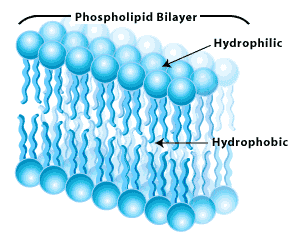
Lipids are a secondary energy source. More importantly, phospholipids (a type of lipid), are a major component of cell membranes - the protective "envelope" that surrounds cells.

The structure of phospholipids comprise a hydrophilic (water-attracting) head and a hydrophobic (water-repelling) tail. As a result of these chemical properties, phospholipids tend to adopt a "bilayer" conformation where the hydrophilic heads are in contact with water, and hydrophobic tails are hidden away from water. This phospholipid "bilayer" is functionally important in cell membranes.
3) Proteins
Proteins form all the "working" structures of our cells. This class of macromolecules have many, diverse functions. These range from enzymes which drive chemical reactions; to ion channels in our cell membranes that control what goes in and out of cells; to structural components like the cytoskeleton which gives cells their shape. Hence, proteins must be able to adopt many different structures to suit their many, diverse functions.

Nature has enabled proteins to fulfill their roles by designing 22 different building blocks which can go into making up a protein molecule. These protein building blocks are called "amino acids". There exist about 22 amino acids, all with different biochemical properties which Nature can "pick and mix" together to make a particular protein. Thus, Nature can "customise" a specific protein structure to a correspondingly specific biological function!

4) Nucleic acids
This class of macromolecules include DNA (deoxyribonucleic acid) and RNA (ribonucleic acid). In contrast to proteins, nucleic acids have only 1 primary function. That is to store information. One may think of nucleic acids as the macromolecule that functions as an "instruction manual" for the cell.

All cells must be able to "read" this "instruction maual". Therefore, the structure of nucleic acids is very uniform in all cells. As most of you would know, DNA has the famous "double helix" structure. The instructions encoded in a DNA molecule comprise of just 4 letters - "A", "T", "C" and "G". In RNA, these are "A", "U", "C" and "G".

In my next post, I will talk more about DNA and how we "read" the "instructions" encoded in this macromolecule.

As for now...I hope you have come to understand what the heck are macromolecules and why the heck they are in our cells!

Tuesday, December 18, 2007

Let's start from the very beginning...

Going easy today. Hope you enjoy this "old school" movie video of one of the best loved songs ever! I remember going to see this movie when I was a kid and loving every moment of it. A true classic!

Why have I put this in my blog today? Well, my dearest girlfriend, who is science illiterate, has been so nice as to try to read through my last 2 posts. But, still she remains clueless!

For this dear friend and all who are still clueless about my writings, I shall "start from the very beginning because that's a very good place to start. When you read, you begin with A B C, when you sing, you begin with Do Re Mi" and when you learn biochemistry, you begin with carbohydrates,lipids,proteins and nucleic acids - the 4 major macromolecules of life.

I believe anyone and everyone can understand science. You just have to grasp the basic "notes" and then you'll be able to "sing a song". And it is for this reason that I have created this blog!

So! Look out for my next post where I will explain "What the heck are macromolecules anyway?". See ya!